Millions of people are attracted to the idea of making money for drone operations. With the propeller noises during flight, aerial views at 400-feet, and bird-like data collection abilities, it’s no surprise that this is viewed as an exciting job.
People often get into drone activities because they want to get some unique holiday photos or discover their neighbourhood from a new perspective. If drone flying is your hobby, have you considered turning it into a successful career path? Your device could become an essential tool for an exciting professional future.
In Australia, the drone industry continues to expand rapidly. The global drone technology industry values in the billions of dollars, generating massive demand for certified drone operators who excel beyond basic flight abilities. These experts play a vital role in transforming business sectors, improving safety measures, and generating visually outstanding content.
In this guide, we’ll lead you from drone operation to financial gain. We’ll examine well-known revenue streams, explore hidden business possibilities, and deliver necessary business guidance for launching your drone venture. By the end, you’ll be on your way to becoming one of Australia’s most sought-after “drone-trepreneurs”.
The Foundation: Why a License is Your Golden Ticket
Before discussing profitable drone ventures, it’s important to establish certification as the essential element which distinguishes commercial drone professionals from casual operators. Any drone operator who performs paid work in Australia must operate commercially according to CASA standards for safe and legal operations.
The Non-Negotiable First Step: Your Remote Pilot License (RePL)
A RePL functions as the essential qualification needed to launch your drone career. This CASA-authorised qualification demonstrates your completion of official training along with expert-level drone operation abilities through both theory and practical assessment.
Commercial drone operation with sub-2kg drones falls under the “Excluded Category” which does not require a license, just a simple Operator Accreditation, yet this path offers very restricted access to valuable work opportunities.
Whether you’re going for a full RePL or fall into an “Excluded Category”, all commercial drones must be registered with CASA. Flying an unregistered drone can result in heavy fines.
The RePL is key to success, because running a business without the correct certification leads to enormous penalties and potential closure of your commercial drone operations. Major corporations in mining, construction, and media, along with government agencies, will not hire pilots without certification. Plus, insurers will only provide public liability insurance to certified operators.
Core Money-Making Avenues: The Pillars of the Drone Industry
It’s important to first understand the fundamental commercial drone services that support the industry base. These core business areas serve as a solid foundation for growing your business operations.
1. Aerial Photography and Videography
The demand for high-quality aerial imagery drives people to establish drone businesses for this primary reason. Specialisation is the key to successful drone business operations. Some areas include:
- Real Estate and Architecture: This application goes further than basic aerial photography of houses. The market has shifted toward demanding professional video walkthroughs with seamless inside-to-outside transitions alongside progressive images for big construction sites. Real estate drone photography services bring in between $200 and more than $1,000 per mission based on complexity levels.
- Weddings and Live Events: Drone aerial capture of weddings and live events provide spectacular views at an elevated price point. Events also include concerts, festivals, and sporting events. Safe operation near crowds while obtaining perfect fleeting moments requires highly skilled FPV drone pilots.
- Commercials, Film, and TV: Aerial cinematography is at its peak level in the commercial film and television industry. FPV (First-Person View) pilots are in high demand for their ability to capture thrilling, fast-paced shots for everything from car commercials to blockbuster films. Experienced pilots in this sector receive daily compensation between $800 and more than $2,000.
2. Asset and Infrastructure Inspection
This drone industry sector is one of the most significant and rapidly expanding areas. The inspection of critical infrastructure through drone technology provides safer and quicker methods at lower costs compared to conventional methods that use rope access, scaffolding, or expensive helicopter services.
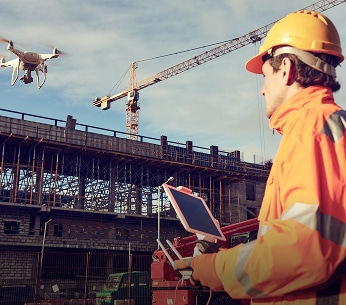
- Construction and Engineering: Drones operate at construction sites to provide project status tracking while performing safety evaluations and producing 3D models that link with Building Information Modelling (BIM) software systems. The gathered data reduces mistakes while maintaining project timelines.
- Energy and Utilities: This is a massive field. Power grid inspection, solar farm cell evaluation, and wind turbine inspection require pilots who have obtained licenses for these activities.
- Telecommunications and Roofing: Drone technology enables safe assessments of mobile phone towers and roof damage inspections for insurance claims, thus eliminating the requirement for dangerous technician heights.
From Drones to Dollars: Creative and Niche Business Ideas
Beyond the standard core services, there is also a range of unique market opportunities that enable licensed pilots to obtain high-end compensation.
1. The Precision World: Surveying, Mapping, and 3D Modelling
Drones shift beyond their basic aerial camera function to become advanced data collection instruments in this domain. This work requires delivering exact data which leads to financial savings of millions for clients.
- Precision Agriculture (Agri-tech): The Australian agricultural sector provides an ideal environment for drone-based innovations in precision farming. Specialised multispectral cameras enable you to provide essential information about crop health, water stress indicators, and weed infestation detection to farmers. The technology enables “smart spraying”, because it allows precise fertiliser and pesticide delivery only to specific areas which reduces costs while maximising crop production. Your ability to create exact land maps helps irrigation planning operations. Farmers invest large amounts of money in these services because they generate substantial returns on their investments.
- Mining and Resource Management: The mining industry and resource management sector employ drones to accomplish multiple essential functions. Pit surveying, environmental compliance monitoring, and stockpile volume measurements represent the most frequent drone applications in this sector. Aerial drone surveys complete stockpile volume calculations more accurately and safely than ground-based survey teams can in several hours of operation.
- 3D Modelling for Heritage and Insurance: This offers the capability to produce exact 3D models of historical sites for preservation purposes, alongside the ability to create precise 3D models for insurance claims and legal evidence through accident site documentation. The provision of this service needs specialised equipment and expertise but delivers unique and valuable solutions.
Your path to success requires drone equipment with RTK (Real-Time Kinematic) or PPK (Post-Processing Kinematic) precision and mastery of DJI Terra software.
2. The Adrenaline Rush: First-Person View (FPV) Services
FPV flying exists as a separate discipline from regular drone operations. Through goggles, the pilot receives a live drone nose feed that creates a completely immersive flying experience. Standard drones cannot perform the dynamic and agile flight paths which FPV technology enables.
- Cinematic FPV: This is the most lucrative FPV niche. FPV pilots develop spectacular “fly-through” experiences to explore commercial properties, offices and factories, and they record intense sequences for film productions and sports events. A single unbroken shot that tracks a racing vehicle through its track or enters a building through a window demonstrates the magic of FPV.
- FPV Drone Racing: Competitive drone racing is a specific niche in the drone community that is growing in popularity with financial backing, sponsorship programs, and an enthusiastic participant base. Experienced racers can earn additional income by making content for YouTube and through sponsorships.
- Creative Marketing Content: Brands continuously seek original content to go viral across their platforms. An expert FPV drone operator uses their flying abilities to generate short action-packed social media content that grabs the attention of users scrolling by.
To master FPV, you need to dedicate hundreds of practice hours starting from simulators alongside deep expertise about drone construction and maintenance. The financial benefits for experienced FPV cinematography pilots reach between $1,500 to over $2,000 daily.
3. The Educator and Consultant: Sharing Your Expertise
After establishing yourself as an experienced and licensed pilot, you can transform your expertise into profit through teaching activities.
- Drone Flight Training: Provide one-to-one flight instruction to novices who acquired their drone and want to learn fundamental safe flight techniques.
- Specialised Workshops: Organise fee-based workshops focusing on particular topics such as “An Introduction to Aerial Photography”, “Mastering Drone Videography”, or “Getting Started with FPV”.
- Corporate Consultation: Large corporations need assistance to establish their internal drone programs so they can build drone capabilities in-house. You can guide organisations through selecting their equipment, developing safe operating procedures, and ReOC acquisition process by serving as a consultant.
4. The Public Good: Emergency Services and Environmental Conservation
Public safety organisations and environmental agencies use drones as essential tools in their operations. The implementation of this work requires external certified contractors, although some organisations maintain their own drone teams.
- Search and Rescue (SAR): A drone system that includes thermal camera functionality enables powerful searches for missing people in challenging environments through its ability to detect heat signatures while scanning extensive areas swiftly.
- Bushfire Support: Drone technology delivers essential situational awareness to incident commanders during bushfires, because it allows them to detect hotspots and track fire movement while protecting manned aircraft pilots from dangerous situations.
- Environmental Monitoring: This is a huge and growing field. Your professional services include working with government agencies and environmental groups for wildfire surveys, coastal erosion monitoring, illegal logging detection, and waterway and reef system health assessments.
Building Your Drone Business: From Pilot to Entrepreneur
The skills and license represent only one part of the equation. The path to business success requires a mindset shift toward entrepreneurial thinking.
- Do Your Market Research: Start by researching your market instead of trying to appeal to every potential customer. Find an industry segment which motivates you and demonstrates market demand in your neighbourhood. Identify your competition, then determine elements which differentiate your service from others while providing superior quality.
- Invest in the Right Gear: Invest in equipment that matches the specific needs of your chosen market segment, because different drones serve different purposes. Choose equipment that matches your specific niche rather than wasting money on the costliest drone available on the market. Plan for additional batteries, premium filters, and robust cases when creating your investment plan.
- Create a Killer Showreel: A stunning showreel represents your most powerful tool for marketing in visual drone work. Your portfolio represents everything in the world of drones. It needs to display high-quality material. A professional website serves as a portfolio display platform, alongside building a strong presence on Instagram and YouTube.
- Network and Market Yourself: Promote your new business through marketing efforts and campaigns. Your professional growth will benefit from participation in local business groups, attendance at industry events, and relationship building with professionals who need your drone services.
- Price Your Services Strategically: Your service rates should depend on your level of experience together with the complexity of each project and your ability to deliver value. Your payment structure might consist of hourly fees, daily charges, or fixed rates for individual projects. The prices set by professionals in your niche should serve as your research starting point but establish yours based on your work quality. A novice pilot might charge $20 per hour, while experienced drone professionals working on advanced assignments can earn between $2,000 to $4,000 weekly.
Your Future is Cleared for Take-Off
The drone industry in Australia provides numerous opportunities that form an exciting business environment. Licensed drone pilots contribute value while enhancing safety and creating new operational efficiencies across the entire spectrum from the Pilbara mines to our capital city skyscrapers.
Your career potential is vast, since you will determine your success through your creativity, professional skills, and personal drive.
Each drone path offers a unique pathway for drone operators to find their perfect match between technical work and artistic skills. Every drone career path starts with dedication to professional conduct alongside safety standards and top-quality execution.
Your commitment to professional excellence is demonstrated by your Remote Pilot License. Your license represents the fundamental basis which will support your entire drone business operation while proving your professional competence for this exciting industry. The sky is no longer the limit; it’s your new office.
Are you ready to convert your drone enthusiasm into a career path which enables these amazing opportunities? Your first step must be certification acquisition. Join Global Drone Solutions to pursue your CASA-certified Remote Pilot License (RePL) training. As Australia’s leading drone organisation, we are here to guide you from drone pilot to drone entrepreneur status.